
Google Ads in 2026: What Small Businesses Need to Know About AI Max, Performance Max, and Search Campaign Basics
Google Ads in 2026 is not a mystery box, but it is less manual than it used to be. That is good news if you run a small business and do not have the luxury of spending half a week naming ad groups like a tax document. The tradeoff is simple: Google is offering more automation, and you need more discipline around goals, landing pages, and measurement.
This guide focuses on the decisions that matter for small budgets: when to use AI Max, when Performance Max makes sense, when Search is still the cleaner first move, and what to check before you spend a single lira or dollar.
Why Google Ads still matters for small businesses in 2026
Small businesses still need fast visibility when people are actively searching for a service, product, or local provider. Organic SEO remains important, but it does not always move on the same timeline as a launch, seasonal offer, or urgent lead target.
Google Ads is useful because it lets you match intent with timing. A search for a service name, repair need, or nearby provider usually signals stronger commercial intent than broad social browsing. Google’s own advertising updates continue to push that direction, with new automation and new ad formats built for search experiences that are more conversational and more dynamic than the old text-ad era.
For the site itself, the same basics still apply: clear service pages, fast loading, obvious contact paths, and content that matches the ad promise. Google Search Central’s SEO Starter Guide and SEO Guide for Web Developers remain the practical baseline for landing pages that do not waste paid traffic.
What changed recently: AI Max, Performance Max, and new Search ad formats
AI Max: more automation, more controls
AI Max is Google’s newer direction for expanding and steering performance with more automation, but also more advertiser controls than a pure “trust us” setup. That matters for small businesses because automation can save time, yet a small budget cannot survive endless experiment theater.
The useful way to think about AI Max is this: it can broaden reach and adapt messaging, but it still needs guardrails. Use it when you already know your offer, your landing page is solid, and you can define what counts as a lead or sale. Google’s 2026 AI Max updates also emphasize ways to steer performance rather than simply handing the steering wheel to the algorithm and hoping for civic virtue.
Performance Max: broad reach, broad responsibility
Performance Max remains the most flexible and broad-reaching campaign type. It can show ads across multiple Google surfaces and mix assets into different placements. That can be helpful when you want more inventory and have enough conversion data to guide the system.
For a small business, the real question is not whether Performance Max is modern. It is whether you are ready for the loss of some manual control. If you need tight keyword visibility, Search may still be cleaner at the start. If you need broad coverage and already have reliable conversion tracking, Performance Max can be worth testing. Google’s own guidance on Performance Max fluctuations and troubleshooting is a reminder that automation is not the same thing as immunity from problems.
New Search ad formats: better relevance, not magical relevance
Google’s 2026 Search ad updates lean into richer, AI-assisted experiences. The practical benefit is more flexible ad presentation for searchers and more ways to match queries to useful ad messaging. The practical risk is the usual one: if your site and offer are vague, the system cannot save you from vagueness, only distribute it at scale.
If you want the official product direction, review Google’s Ads and Commerce news hub and the Search-ad updates announced in 2026. Start with the Google Ads & Commerce news and updates page and the announcement on new Search ads for the AI era of Search.
Choosing the right campaign type for a small budget
There is no universal winner. There is only the right campaign for the business problem in front of you.
| Campaign type | Best when | Watch out for |
|---|---|---|
| Search | You want intent-based traffic, clear keyword control, and easier learning at the start | Overbroad keywords, weak landing pages, and narrow ad copy |
| Performance Max | You have solid conversion tracking and enough assets for broader reach | Less visibility into exact search terms and too little budget to learn properly |
| AI Max | You want more automation and you already understand your conversion path | Handing over too much control before you know what good performance looks like |
For many small businesses, the cleanest first step is still Search. Start with a limited, high-intent keyword set, then expand only after you have enough data to judge what is happening. Automation is useful. Blind faith is not a strategy.
How to structure a first campaign: goals, keywords, locations, and assets
1. Set one primary goal
Decide whether the campaign is for calls, form submissions, store visits, quote requests, or online purchases. Do not mix three objectives into one campaign unless you enjoy arguing with your own dashboard.
2. Choose keywords that match real buying intent
Use specific terms that reflect the service and the buyer’s stage. For example, a small web design firm should think in terms such as “web design company near me,” “small business website design,” or “responsive website service,” rather than broad terms like “website” or “digital.” Broad terms can spend money very efficiently. Unfortunately, they can also spend it on the wrong people just as efficiently.
Google Ads’ own help resources and the broader Google Search guidance both point back to the same principle: relevance is a system property, not a setting.
3. Define your location settings carefully
If you serve a city, region, or specific market, set that explicitly. Avoid the common mistake of targeting too wide while assuming the algorithm will somehow infer your actual service area. Algorithms have many talents. Mind reading remains aspirational.
4. Build assets that support the ad
Search ads still need strong headlines and descriptions. Performance Max and AI Max need even more structured inputs: good headlines, concise descriptions, useful images, and a landing page that reinforces the same offer. If your ad says one thing and the page says another, the click becomes a tax on confusion.
When the campaign supports a service page, internal consistency matters. If you want a broader service context, link to the web design services page, the online advertising page, and the hosting and domain information page so readers can compare the supporting pieces of the site before they enquire.
What to track in Google Ads and Search Console after launch
The first week is not the time to panic because the campaign did not conquer the earth. It is the time to see whether the basics are working.
- Conversions: calls, forms, purchases, or other lead actions you actually care about.
- Cost per conversion: enough to judge efficiency, not enough to panic after a day.
- Search terms and relevance: especially for Search campaigns.
- Impression share and lost rank or budget: whether the campaign is constrained.
- Landing page engagement: bounce patterns, time on page, and contact interactions.
- Search Console signals: indexing, page appearance, and query patterns around the landing page.
Google Search Console is especially useful when you want to know whether the landing page itself is healthy. If the page has indexing problems, slow performance, or thin relevance, paid traffic usually exposes the weakness faster than organic traffic does. That is not a feature anyone advertises, but it is dependable.
For a more complete service-stack setup, see the homepage for the broader web design, hosting, and SEO context, and review the references and portfolio page when you want proof that the business can support the work it sells.
Common beginner mistakes to avoid in 2026
- Launching before tracking works: no conversion tracking means no useful learning.
- Using broad keywords too early: budget leaks are still budget leaks, even when they come with advanced interfaces.
- Sending traffic to a weak page: automation cannot rescue a poor landing page.
- Changing too much too fast: make one major change at a time so you can understand cause and effect.
- Ignoring Search Console and site quality: the ad may win the click, but the site has to win the next ten seconds.
- Assuming Performance Max or AI Max is automatically better: not every business needs the most automated option first.
When to get help from a web design, SEO, or ads partner
You should consider outside help when the campaign has traffic but no useful leads, when tracking is incomplete, when the site is not credible enough to support paid clicks, or when you do not have time to manage the weekly tuning that paid search requires.
A good partner should be able to look at the whole system: campaign structure, landing page quality, hosting reliability, page speed, and conversion tracking. That is why paid traffic is rarely just an ads problem. It is usually a site problem wearing an ads hat.
If you want a practical next step, review the site’s supporting pages, check whether the landing page is fast and clear, and then decide whether to manage the campaign in-house or with help. If your team needs both web and ads support, start with the service pages and the contact page to request a review.
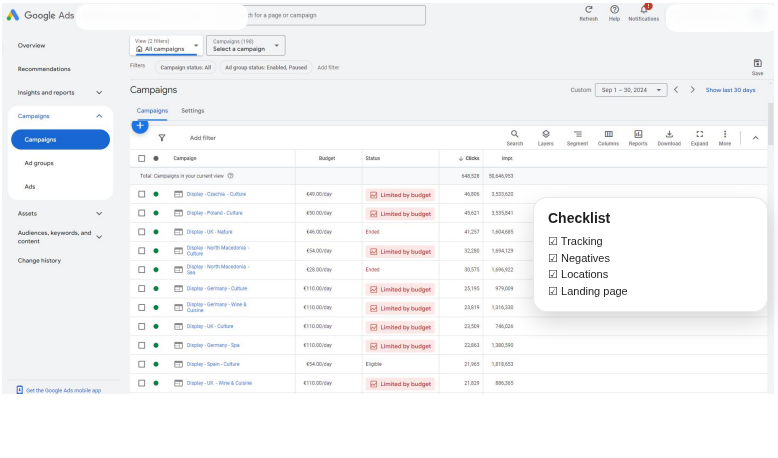
A practical first-30-days checklist
- Pick one primary goal.
- Use a narrow keyword list or tightly defined assets.
- Set location targeting to the real service area.
- Make sure conversion tracking is verified before launch.
- Check landing page speed and message match.
- Review search terms and asset performance weekly.
- Only expand after you can explain what is working.
Google Ads in 2026 is more capable than it was a few years ago. That does not change the basic business rule: spend where intent is clear, measure what matters, and keep the landing page honest. The platform may be getting smarter. Your budget still deserves supervision.