
Launch-month SEO is mostly an order-of-operations problem. First make the site discoverable, crawlable, and verifiable. Then improve the pages that matter. Doing those in reverse is how people spend a week “optimizing” a page search engines still cannot reach.
New site owners usually ask the same questions after launch. Should I submit the sitemap on day one? Do I need to request indexing for every page? Should I keep editing titles and copy immediately, or wait for indexing data first? And how do I tell the difference between “nothing is ranking yet” and “the setup is actually broken”?
For broader planning context, teams can compare guidance from Google Search Central before choosing a workflow.
The clean answer is to separate SEO registration from SEO optimization. Registration is the discovery layer: indexability checks, verification, canonical cleanup, and sitemap submission. Optimization is the improvement layer: stronger page copy, better titles and headings, cleaner internal links, performance fixes, and a monitoring loop. If you need a broader view of how these pieces fit together across design, hosting, and promotion, start with the main website overview. The service stack matters because SEO problems often begin upstream in structure, hosting, or launch QA.
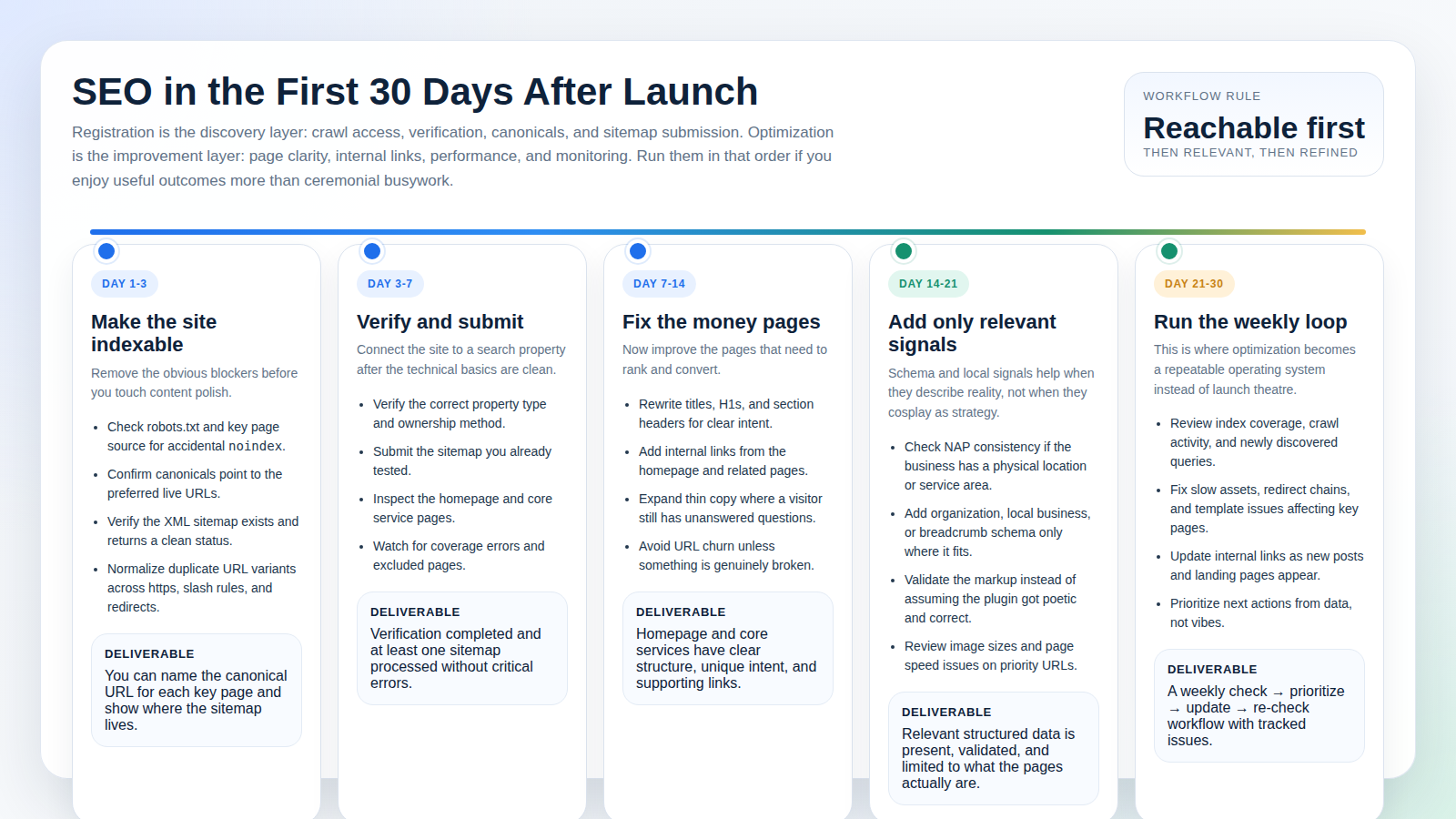
Here’s the workflow I’d run in the first 30 days: make the important pages reachable, verify the property, submit what matters, improve the money pages, then iterate from crawl and coverage signals instead of chasing rankings on day four. Rankings may move later. The first month is about proving the site can be found, understood, and trusted by both crawlers and people.
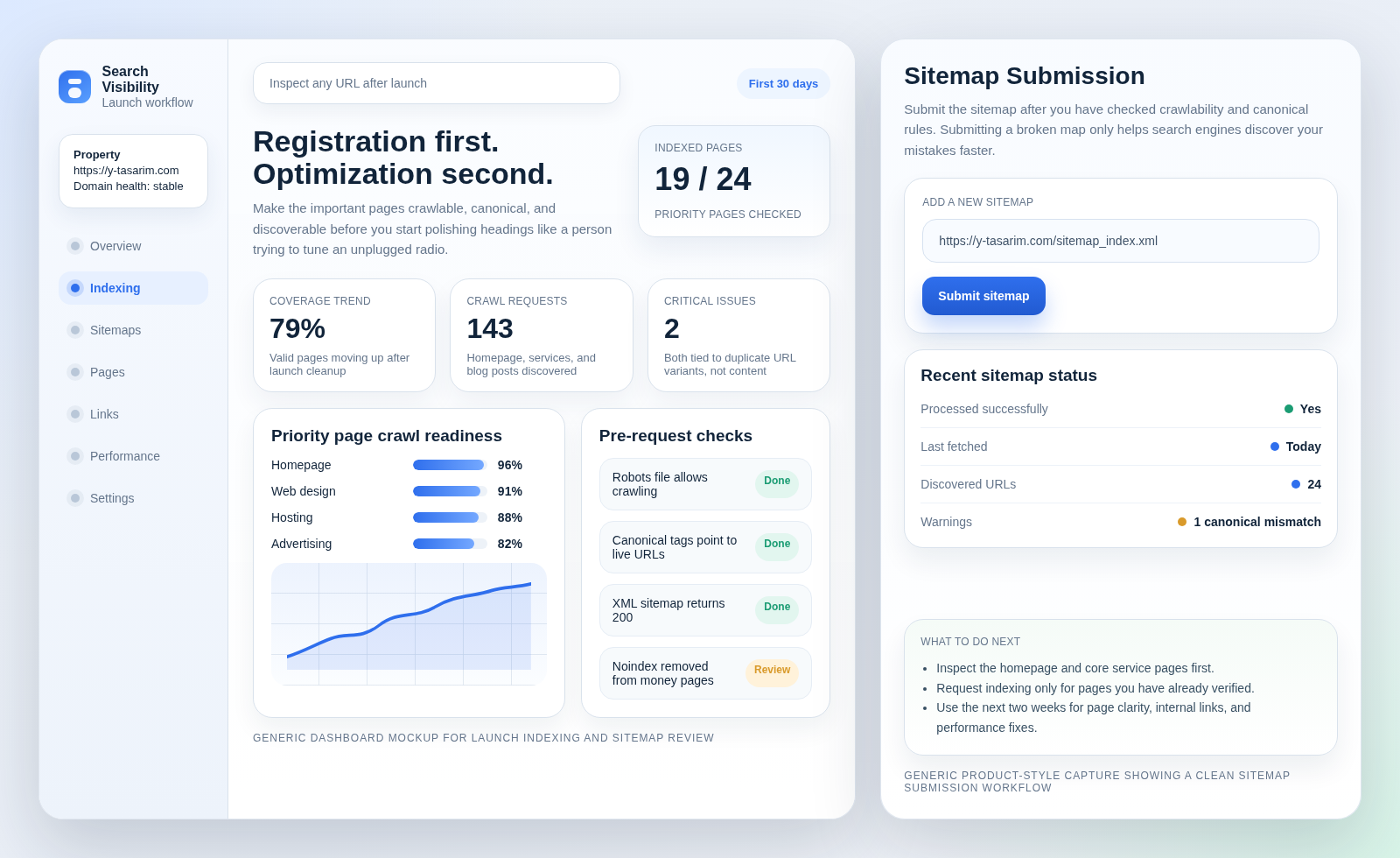
SEO Registration vs. Optimization: Quick Definitions
Registration is about making sure search engines can discover, crawl, and index the pages you want to appear in search. Optimization is about making those pages clearer, more relevant, and more useful after the discovery layer is working. The distinction sounds obvious until a launch team starts editing meta titles while the site is still blocked by a stray noindex tag.
Related implementation details are also covered in WordPress documentation, which helps keep tool decisions grounded in established practices.
| Phase | What it covers | Main question | Typical outputs |
|---|---|---|---|
| Registration | Indexability, verification, sitemap submission, canonical checks, crawl discovery | Can search engines reach and understand the preferred URLs? | Verified property, working sitemap, valid canonicals, crawlable priority pages |
| Optimization | Content quality, on-page structure, internal links, performance, structured data where relevant | Are the important pages clear, useful, and strong enough to compete? | Improved titles and headings, stronger copy, better routing, cleaner weekly reporting |
Why the order matters: optimization without registration is wasted effort, and registration without follow-up monitoring is incomplete. The first month should feel less like “doing SEO” in the abstract and more like running a launch operating system with dependencies.
Day 1-3: Make the Site Indexable
The first three days are for removing blockers. This is not glamorous work. It is also the work that prevents the expensive kind of confusion later.
Checklist for Day 1-3:
- Check
robots.txtand page-level source code for accidentalnoindexor disallow rules on key URLs. - Confirm canonical tags point to the live preferred URL, not staging, not a duplicate variant, not a cleaner-looking fantasy URL someone forgot to build.
- Make sure an XML sitemap exists, loads normally, and includes the pages that should be discoverable.
- Normalize core URL variants:
httpvshttps, trailing slash behavior, and obvious duplicate entry points. - Verify that navigation and footer links route visitors to the main service pages from the homepage.
For most small business launches, the minimum priority set is straightforward: homepage, main service pages, contact path, and any core landing pages tied to demand. On this site, that means checking the homepage plus the service pages for web design, hosting and domain guidance, and online advertising. If those pages are not crawlable, the rest of the month becomes an exercise in decorative effort.
Deliverable by Day 3: you can answer three questions without guessing. What is the canonical URL for each key page? Where is the sitemap? Are the key pages indexable?
Day 3-7: Verify Ownership and Submit What Matters First
Once the site is actually indexable, move into verification and submission. This is the registration phase in its most literal form.
Checklist for Day 3-7:
- Verify the correct search property and use one consistent setup approach.
- Submit the sitemap you already tested, not a placeholder you intend to fix later.
- Inspect the homepage and top service pages individually.
- Review indexing or coverage reports for obvious exclusions, crawl anomalies, or canonical mismatches.
- Request indexing only for pages that are actually ready.
A common mistake here is to request indexing for everything on day one because it feels proactive. It is proactive in the same way sending invitations before you book the venue is proactive. Search engines are fairly good at finding pages, but they are not responsible for cleaning up your launch sequence.
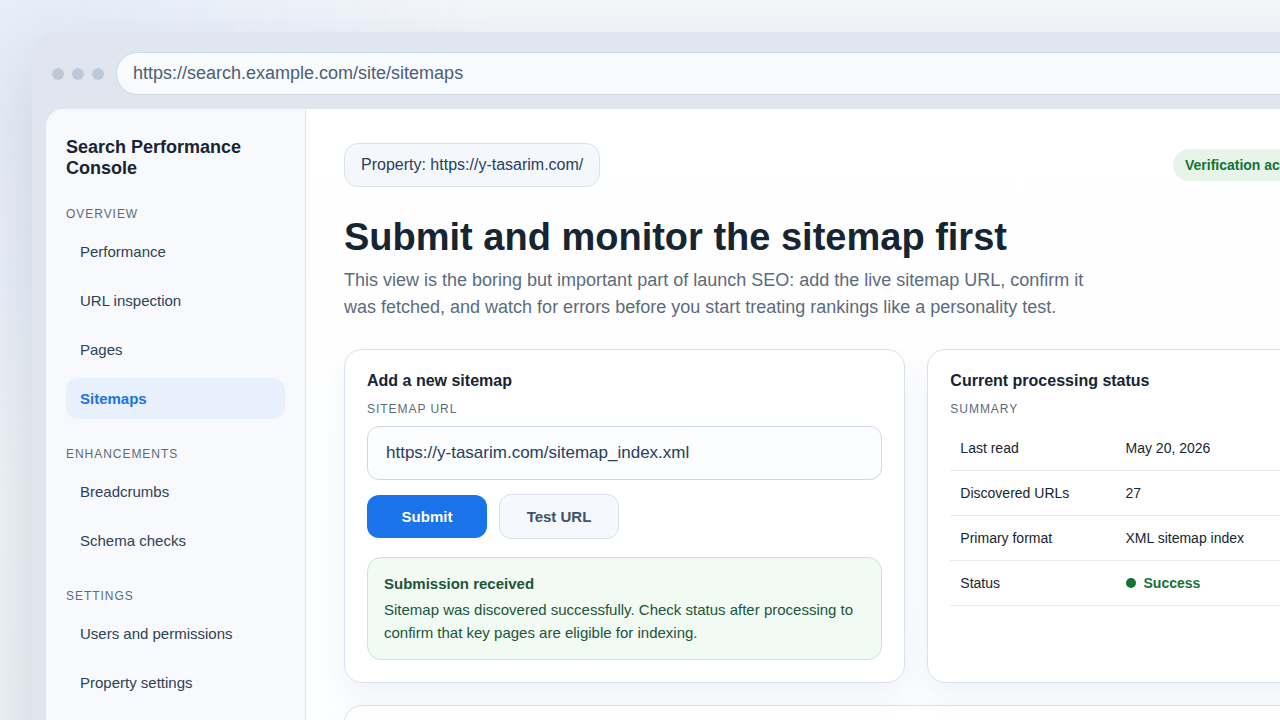
Deliverable by Day 7: verification is complete, at least one sitemap is submitted, and there are no critical errors on the main page set.
Day 7-14: Improve the Money Pages First
Now optimization begins. Not everywhere. Start with the pages that matter most for visitor intent and business value.
Checklist for Day 7-14:
- Review page titles, H1s, and section hierarchy for the homepage and core services.
- Clarify page purpose. Each priority page should answer one main intent cleanly before it tries to answer five secondary ones.
- Strengthen internal links from high-visibility pages to core service URLs using descriptive anchor text.
- Expand thin sections where visitors still lack enough context to decide or contact you.
- Keep URLs stable unless something is truly broken. Change content more often than you change paths.
This is the stage where launch teams often try to “do SEO” by editing everything at once. Resist that instinct. A cleaner structure on five important pages beats random revisions on thirty pages with unclear priority. If on-page structure or template logic is getting in the way, that is usually a design and implementation problem, not just a copy problem. That is where focused site structure and web design support becomes more useful than another round of vague keyword tinkering.
Internal linking matters here because it gives both users and crawlers a better routing map. Add clear links from the homepage, related service pages, and relevant articles into the pages that should carry commercial intent. Think of internal links as the site’s navigation layer for meaning, not just a way to make footers longer.
Deliverable by Day 14: your top pages have clear intent, solid heading structure, stronger internal links, and enough substance to deserve indexing.
Day 14-21: Add Local Signals and Structured Data Only When They Fit
Week three is where people get tempted by plugin-heavy checkbox behavior. Use restraint. Structured data is useful when it clarifies reality. It is not a costume department.
Checklist for Day 14-21:
- If the business has a physical location or service area, confirm that name, address, phone, and contact details are consistent across the site.
- Add organization, local business, or breadcrumb schema only if the page actually represents those entities.
- Validate structured data after adding it.
- Review large assets, page weight, and obvious performance issues on the priority pages.
Hosting and DNS decisions can affect this stage more than people expect. Canonical drift, redirect weirdness, slow responses, and mixed environment issues often trace back to hosting setup or domain handling rather than to the content itself. If the launch stack still feels shaky at the infrastructure layer, this is the moment to sort it out with practical hosting and domain guidance before more content work piles on top of it.
Deliverable by Day 21: structured data and local signals are present only where relevant, validated, and backed by a stable technical environment.
Day 21-30: Run the Ongoing Optimization Loop
The last third of the month is where SEO stops being a launch checklist and starts becoming a repeatable operating loop.
Checklist for Day 21-30:
- Review coverage and indexing changes for key URLs.
- Check whether important pages are being crawled regularly.
- Look at early impressions and query patterns without panicking about rank positions.
- Fix slow assets, redirect chains, and layout or template issues that affect important pages.
- Add or refine internal links as new posts, case studies, or landing pages are published.
This is also the point where SEO and advertising should be separated cleanly in your head. Paid campaigns can support visibility while SEO ramps up, but they are not the same system and should not be reported as if they are. If you need short-term traffic while organic discovery is still maturing, the sensible next step is a parallel online advertising plan, not pretending ad clicks prove the registration phase worked.
For more complex launches, especially where a site is part of a larger application rollout, a useful adjacent reference is this overview of custom web development services. It is not an SEO checklist, but it is relevant when the real problem is that product structure, templates, and page logic still need engineering attention before SEO can perform normally.
Deliverable by Day 30: you have a weekly workflow of check – prioritize – update – re-check, and you are using data to choose what to fix next.
Common Mistakes That Delay Results
Most launch-month SEO failures are not mysterious. They are procedural. The pattern is usually “we skipped a dependency and then spent two weeks discussing symptoms.”
| If you see this | Check this first | Why it happens |
|---|---|---|
| Pages are not indexing at all | Robots rules, noindex, canonical tags, sitemap status, coverage reports |
Search engines cannot index what they are told not to index or cannot reliably discover. |
| Wrong page version appears | Canonical targets, redirects, duplicate URL variants | Conflicting URL signals make the preferred page ambiguous. |
| Sitemap is submitted but coverage stays weak | Sitemap freshness, page quality, internal links, server response quality | A sitemap helps discovery; it does not override poor crawlability or thin pages. |
| Traffic is flat after many page edits | Whether the key pages were being crawled and indexed before the edits | Optimization work landed before the discovery layer was healthy. |
| Rankings and URLs keep shifting | Recent slug changes, redirect chains, repeated rewrites during launch month | Constant URL churn resets signals and creates avoidable confusion. |
What not to do:
- Do not optimize pages search engines still cannot reach.
- Do not keep changing slugs during the first month unless a URL is genuinely wrong.
- Do not publish thin duplicates just to make the site feel larger.
- Do not treat “request indexing” as a replacement for actual technical cleanup.
How to Measure Success in Month One
Month-one success is not “we ranked for everything already.” That is not a serious launch metric. Use signals that tell you whether the site is being discovered, processed, and improved over time.
| Signal | What to measure | Why it matters in the first month |
|---|---|---|
| Index coverage | Valid indexed pages compared with the pages you expected to be indexed | This shows whether the discovery and indexability layer is actually working. |
| Crawl behavior | Whether homepage and core service pages are being crawled regularly | Regular crawling is an early sign that search engines are finding the right routes. |
| Impressions and queries | Early visibility trends in search reports | These are leading signals, even when rankings are still unstable. |
| Error trend | Coverage errors, crawl anomalies, sitemap issues, redirect problems | Fewer errors over time usually means the launch stack is getting healthier. |
By Day 30, you should be able to show three things: more of the expected pages are indexed, fewer technical issues are blocking discovery, and important pages are being crawled often enough to justify continued optimization work. That is a sound month-one result even if rankings are still moving.
A Simple Weekly Review Template for the First Month
If you want the first month to stay disciplined, use the same review format every week. The goal is not to admire dashboards. The goal is to turn signals into the next small set of fixes.
| Step | What to review | What comes out of it |
|---|---|---|
| 1. Check | Coverage changes, sitemap status, crawl behavior, page-level issues on priority URLs | A short list of current problems and newly discovered signals |
| 2. Prioritize | Which issues affect the homepage, service pages, and highest-intent landing pages first | A ranked action list instead of ten equally urgent distractions |
| 3. Update | Titles, headings, copy, links, templates, redirects, or performance items that actually matter | A focused batch of changes you can trace back to a reason |
| 4. Re-check | The same URLs and reports the following week | Evidence that the fix helped, did nothing, or created a new issue |
A lightweight review note is enough. Keep one line each for issue, suspected cause, fix applied, and next verification date. That habit prevents the classic month-one problem where everybody remembers editing something but nobody remembers why. SEO gets a reputation for vagueness when the workflow is vague. The work itself is usually more concrete than the meetings around it.
This review rhythm also helps you separate real SEO work from adjacent launch noise. A contact form bug is important, but it is not an indexing issue. A campaign landing page rewrite may be useful, but it is not proof that the sitemap is healthy. Treat each issue according to its layer: crawlability, page quality, conversion flow, or paid acquisition. Systems behave better when the labels are accurate.
When to Ask for Help
Sometimes the right decision is not “do more SEO.” It is “stop guessing and audit the system.” Ask for help when:
- important pages still are not indexing after you fixed robots, canonicals, and sitemap issues;
- coverage and crawl errors keep recurring without an obvious technical cause;
- a migration, redesign, CMS change, or URL restructuring is about to happen;
- the real challenge is site architecture, templates, or internal linking design rather than individual title tags.
If the problem is structural, start with the right service lane. Use web design and development support when page architecture and templates need work. Use hosting and domain guidance when infrastructure, redirects, DNS, or performance are part of the issue. Use online advertising support when you need a separate paid visibility channel while organic search matures. And if you want to see how finished work is presented publicly, the references and portfolio page shows the kind of delivered outcomes the site is built around.
The short version: first make the site reachable, then make the important pages stronger, then run a weekly loop based on coverage, crawl behavior, and real signals. SEO in month one is not a magic trick. It is mostly disciplined sequencing, which is less glamorous but much more useful.